
Why B2B Companies Are Rediscovering SMS
For years, SMS was primarily seen as a transactional or B2C marketing channel. Appointment reminders, promotional campaigns, delivery notifications… its use in B2B environments remained relatively limited.
But business behaviors have changed dramatically.
Today’s decision-makers are:
- overwhelmed by emails,
- increasingly difficult to reach by phone,
- and less responsive to traditional outbound approaches.
In this context, conversational SMS is emerging as a powerful new communication channel. More direct, more personal, and more immediate, it is gradually becoming a real B2B business development tool — especially when combined with artificial intelligence.
Why B2B Companies Are Rediscovering SMS
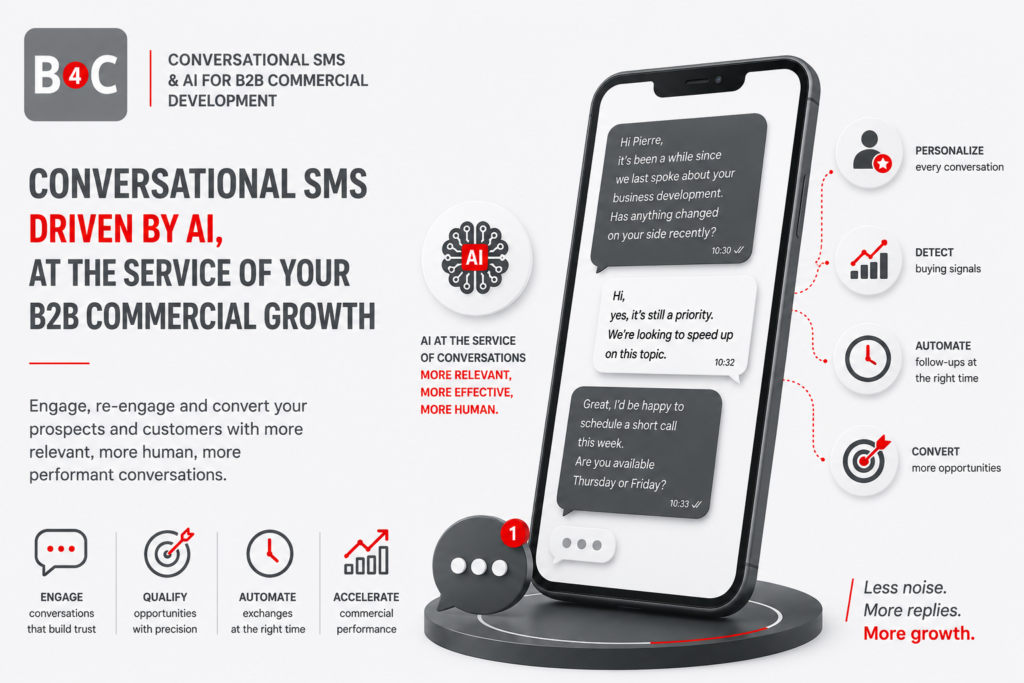
Conversational SMS is not about sending mass promotional messages.
The objective is different:
to initiate a simple, contextualized, and human conversation with a prospect or an existing client.
For example:
“Hello Peter, we spoke some time ago regarding your commercial development strategy.
Has this become a priority again on your side recently?”
This is very different from traditional “SMS marketing”.
Conversational SMS is based on:
- personalization,
- existing business context,
- two-way interaction,
- and a conversational objective rather than mass broadcasting.
The Solution: Outsource — But Do It Right
Outsourcing doesn’t mean giving up control.
It’s a strategic decision to delegate a specialized task to those who know how to do it — fast and well.
Effective prospecting requires:
- A clear method
- Dedicated time and consistency
- High-level communication skills
Beware: outsourcing is not automation.
Using software tools or offshore juniors to blast messages rarely brings qualified meetings.
It generates noise — not real leads.
At B4C, we believe that prospecting should remain human, focused, and expert-driven.
Why This Channel Is Becoming So Powerful in B2B
1. Email Is Reaching Its Limits
B2B email response rates continue to decline while inboxes are becoming increasingly saturated.
Meanwhile:
- SMS open rates remain close to 98%,
- and most messages are read within minutes.
SMS creates a level of attention that has become increasingly rare in business communication.
2. Conversational SMS Reduces Friction
A phone call can feel intrusive.
An email often requires too much reading time.
SMS enables quick, lightweight, and natural interactions.
It is not designed to sell immediately.
Its primary role is to reopen the conversation.
3. Decision-Makers Expect Simplicity
Executives and senior decision-makers increasingly prefer:
- concise exchanges,
- contextualized outreach,
- and useful conversations.
Conversational SMS aligns perfectly with these evolving expectations.
The Critical Role of Artificial Intelligence
AI is fundamentally transforming the way companies use conversational business messaging.
It does not replace human relationships.
Instead, it enhances relevance, timing, and efficiency.
AI Makes It Possible To:
Personalize Messaging at Scale
Messages can be adapted based on:
- industry,
- decision-maker profile,
- relationship history,
- or identified business challenges.
Detect Buying Signals
Responses can be automatically analyzed to:
- identify warm opportunities,
- qualify business needs,
- and prioritize follow-ups.
Automate Re-Engagement Sequences
AI can manage:
- follow-up timing,
- conversational workflows,
- reminders,
- and nurturing sequences.
Improve Commercial Productivity
Sales teams can then focus their time on:
- high-value conversations,
- qualified meetings,
- and active opportunities.
The Most Effective B2B Use Cases Reactivating Dormant Prospects
This is currently one of the most effective applications.
Many companies sit on underutilized CRM databases containing:
- inactive prospects,
- lost opportunities,
- former clients,
- or dormant accounts.
Conversational SMS enables companies to restart conversations in a natural and non-intrusive way.
Post-Meeting Follow-Ups
After an initial sales interaction, conversational SMS helps:
- maintain momentum,
- follow up without pressure,
- and avoid losing engagement.
Meeting Generation
Conversational SMS is particularly effective for:
- confirming interest,
- proposing a short discussion,
- and scheduling meetings quickly.
Reactivating Existing Clients
Many companies underestimate the value of their existing client base.
Yet former clients already know:
- your company,
- your expertise,
- and your value proposition.
Conversational SMS allows businesses to reconnect efficiently and naturally.
Why the Hybrid Model (AI + Human Expertise) Will Win
The mistake would be to believe that AI should replace sales professionals.
In reality, the most effective approaches combine:
- AI for outreach, qualification, and orchestration,
- humans for relationship-building and strategic conversations.
In premium B2B environments, this hybrid model is particularly powerful.
It enables:
- greater responsiveness,
- stronger personalization,
- and higher commercial productivity.
An Emerging Market with Significant Opportunity
Today, conversational messaging is already widely used in:
- retail,
- banking,
- e-commerce,
- and customer service.
However, its application to premium B2B business development remains largely underdeveloped.
This creates a major opportunity for companies capable of combining:
- technology,
- conversational intelligence,
- and human commercial expertise.
Toward a New Model of B2B Prospecting
Business development is evolving rapidly.
Mass outbound campaigns and impersonal automation are reaching their limits.
Decision-makers increasingly expect:
- relevance,
- contextual conversations,
- and seamless interactions.
AI-assisted conversational SMS fits perfectly within this transformation.
Not as another marketing tool,
but as a new strategic channel for B2B business development.
Conclusion
Conversational SMS powered by AI is no longer an experiment.
It reflects a broader shift toward:
- more conversational business interactions,
- more direct communication,
- greater personalization,
- and smarter sales engagement driven by data and AI.
Companies capable of combining:
- technology,
- relationship intelligence,
- and senior-level human expertise,
will likely gain a significant competitive advantage in the years ahead.
B4C supports companies in their B2B business development, lead generation, and commercial activation strategies.